


Have you ever wondered how a child’s cognitive abilities develop? I think as a parent we want to do everything we can to help our child develop well. Understanding the stages of development cognitively allows us to have a rich environment in which children can learn and grow. Jean Piaget came up with different stages of development cognitively.
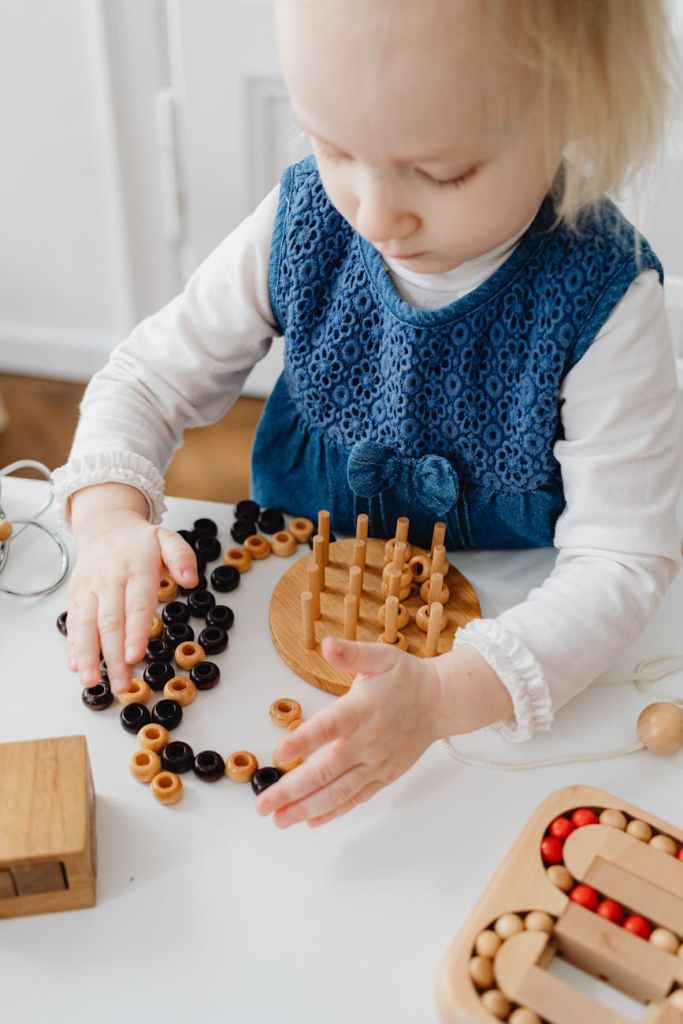
The ability to think cognitively and problem solve is developed through language and communication. When children develop their language and communication skills, they also develop abstract thought processes, reasoning, and problem-solving. It up to a parent or caregiver to provide a stimulating environment for children to learn. An environment that is nurturing, motivates children to learn more easily and impacts their ability to process new information. If a child’s emotions and stress levels are high it does not allow them to learn optimally or process new information.
Social interactions with others that are positive also allow children to develop important cognitive skills that will serve them later in life such as communication, collaboration and empathy.
There are several stages that are part of cognitive development. The first stage is the sensorimotor stage, and this occurs from birth to about age 2. Newborns and those up to two years old learn to coordinate their motor abilities with their senses. Certain toys and learning things are geared to children this age and if you want them to develop these skills it’s a good idea for a child to have access to these.
The second stage is preoperational stage which takes place between the ages of 2-7 years old. Children start to think in symbols at this age and language grows quickly. They begin to use pretend play to explore the world around them and express themselves. The do struggle to see things from another’s perspective and are egocentric at this age.
Next comes the concrete operational stage which takes place from age 7-12 years old. They can understand cause and effect at this stage. This is the stage where they are able to understand the process of cause and effect. They can also understand other people’s point of view. Mathematical operation and classification can be understood at this stage.
Finally, the formal operational stage takes place next and begins at around 12 years old and goes into adulthood. Abstract thinking stats at this stage. Children can use abstract thinking, consider possible situations and use complex reasoning. Advanced problem solving can occur at this stage. More abstract concepts can be understood.
A parent should look into creating a nurturing environment for their child with toys and activities at each stage of development that will foster the different types of cognitive development. Finding the time to read to your child, listen to music together, expose them to different things like museums. Make sure that they are developing close friendships to share communication and support.


Leave a Reply